Unmanned Subsurface Monitoring

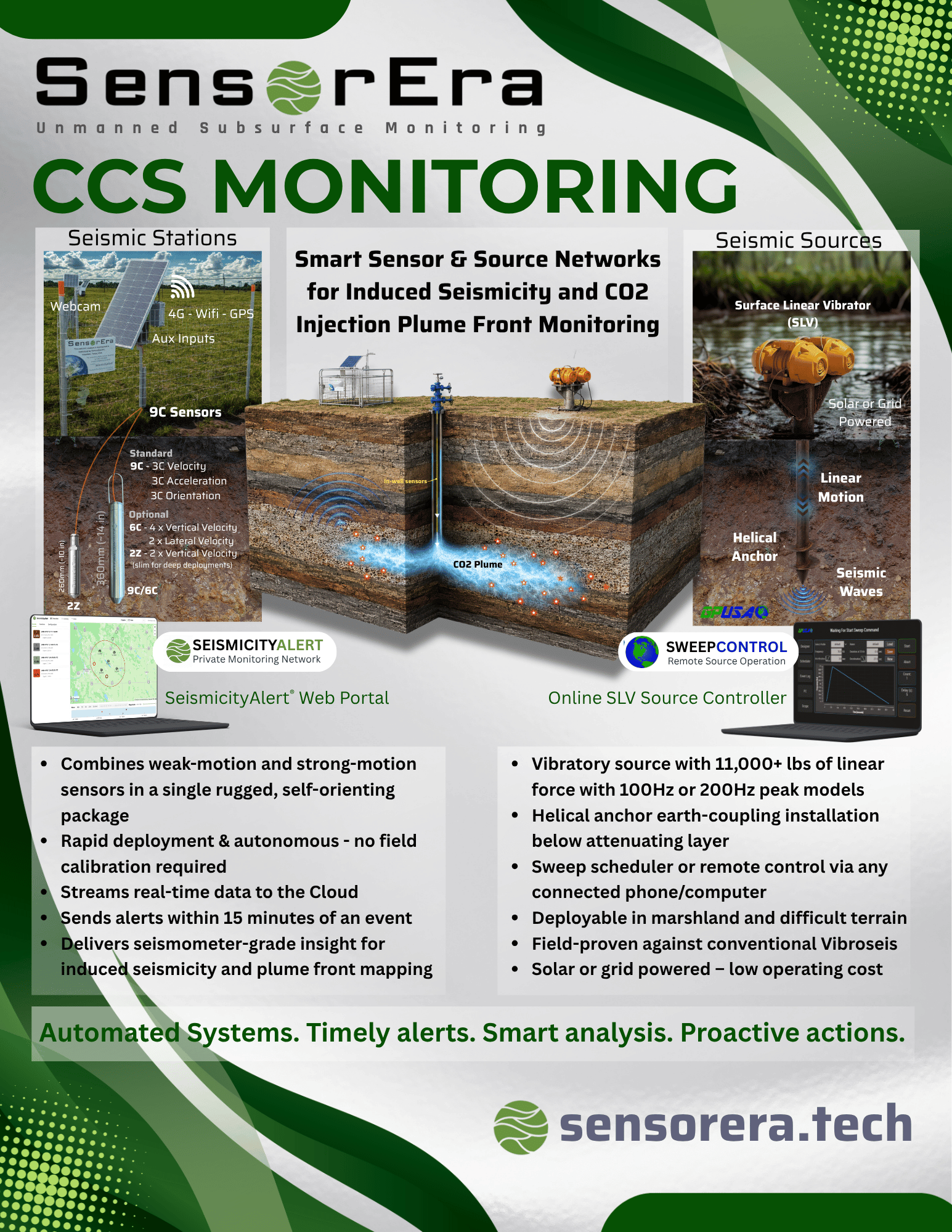
Smart Sensor Networks for Induced Seismicity and Injection Plume Front Monitoring

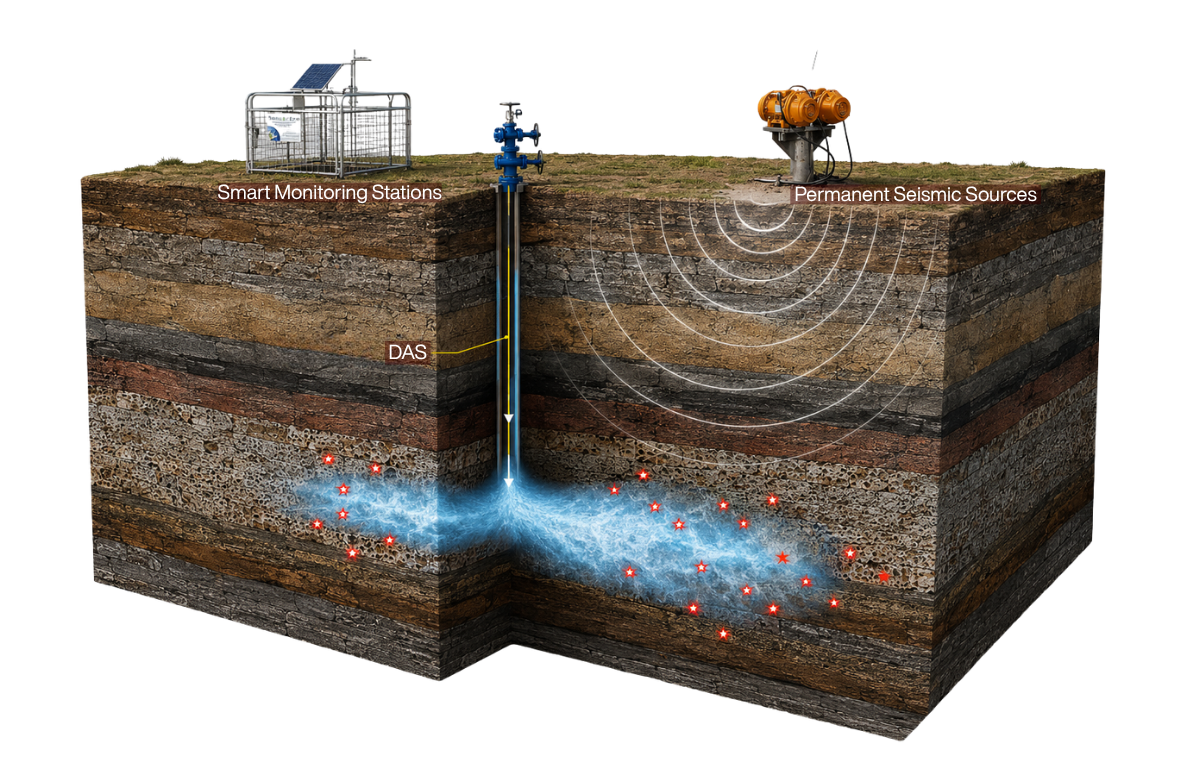
SensorEra designs, manufactures, deploys and operates novel autonomous near-surface and downhole monitoring systems — seismometer stations with optional permanent seismic sources and a real-time cloud portal that ties it all together in an economical and high-value service.
About SensorEra

Purpose-built sensors for subsurface stewardship.

Continuous monitoring of subsurface seismicity is essential for any subsurface injection, geothermal or CCS site. We build cost-effective, densely deployable networks that capture both natural and induced seismicity — before, during, and after injection — alongside an actively-swept, permanent seismic source for on-demand frequent time-lapse plume front detection.

Our seismic stations combine weak-motion velocity sensors with strong-motion MEMS accelerometers, resolving events down to −1.5 Mw while also capturing proximal peak ground acceleration. Data streams via 4G or satellite to a user-friendly cloud portal with configurable alerts by email, SMS, or voice.

See the technology
Services on Offer

End-to-end monitoring for the operational life of the site.

From baseline surveys to post-injection verification, SensorEra delivers the hardware, deployment and data pipeline needed to meet regulatory obligations.

Passive seismic & PGA monitoring

Continuous baseline and operational monitoring to monitor deep seismicity and surface PGA across the region, site or area of interest - monitor your asset

Active & frequent time-lapse surveys

Sparse-array CDP trace tracking with the SLV seismic source — daily or weekly deep subsurface snapshots of multiple singular deep target points - map your asset

Cloud portal & real-time alerts

Near real-time observations streamed to authorized user devices. Priority alerts by email, SMS, or automated voice - be aware of your asset

Integrated sensor gateway

Third-party gas detectors, wellhead pressure, groundwater and weather sensors stream through the same logger to one unified portal - Synergize your asset

Site design & deployment

Pre-survey modelling for sensor placement and geotechnically informed source anchor design with autonomous power and rapid installation — even in challenging terrain like marshland - Optimize your assest

Expert reporting support

Data packaging and event catalogs in formats that align with regulator and operator reporting workflows - Classify your asset

Our Technology

Two complementary systems, one data pipeline.

A dense, cost-effective network of surface seismometer stations captures passive seismicity and active source data, while the permanent Surface Linear Vibrator (SLV) source provides the repeatable, unmanned active seismic energy needed for time-lapse injected plume tracking.

01 — SeismicityAlert® Gen4 Surface Station

Twinned self-orienting nodes. Full-spectrum coverage.

SeismicityAlert® Gen4 includes two distinct sensor packages in a single seismometer station. The nine-component (9C) MEMS-assisted system integrates a three-component (3C) high-sensitivity velocity sensor, a 3C low-noise strong-motion MEMS accelerometer and a 3C magnetometer — resolving microseismic events down to –1.5 Mw. The six-component (6C) geophone array provides four vertical (4×Z) and two horizontal (X+Y) weak-motion velocity channels, optimized for passive monitoring and active-source receiver networks.

After real-time proprietary edge compression, data streams continuously over 4G or Wi-Fi to our cloud computing platform that generates SMS, email or automated voice alerts dispatched within minutes of an event. The station is self-orienting and requires no field calibration or self-test — driving multi-station deployment time to hours, not days and useful real-time data is accessible immediately after deployment.
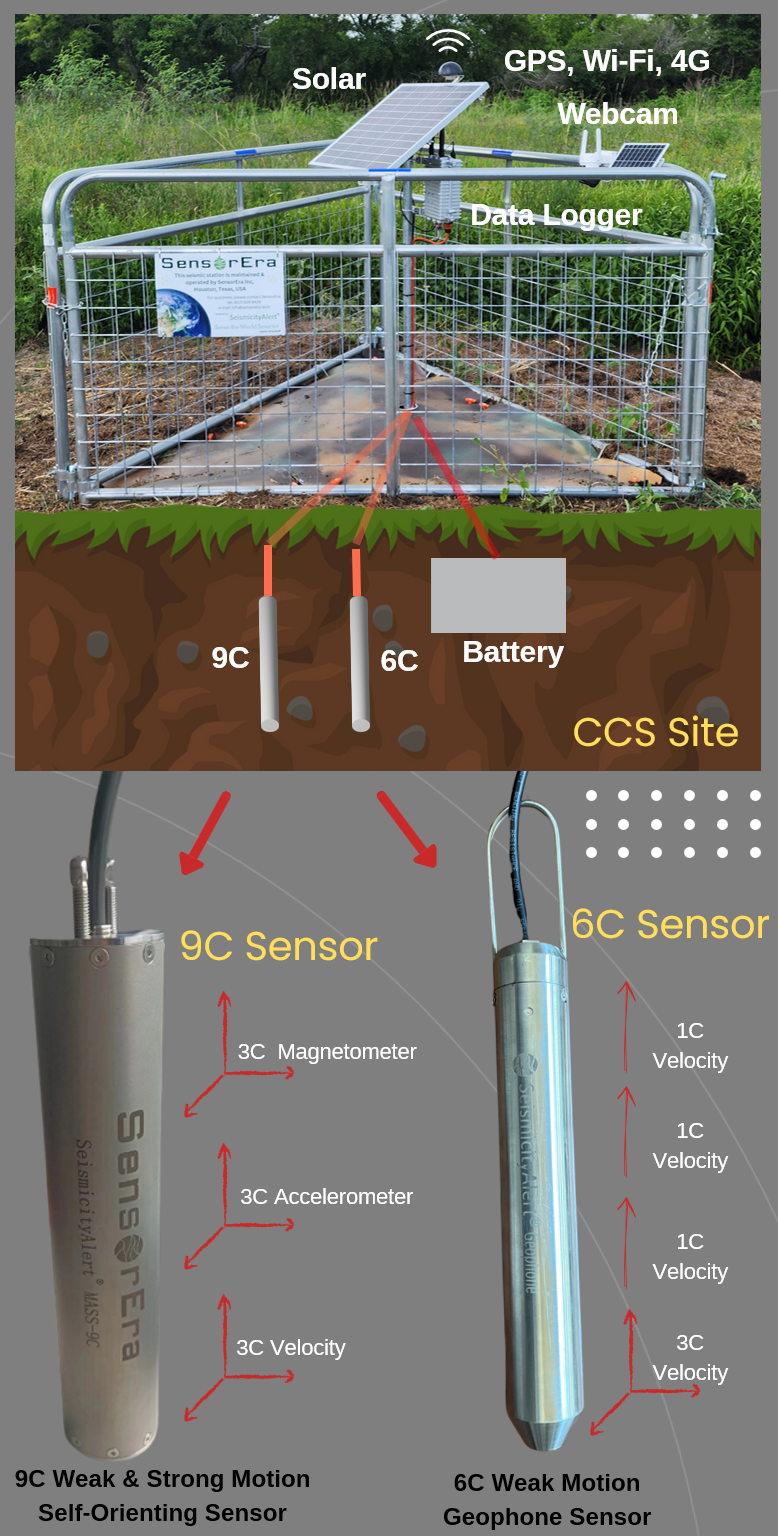
  • 9C sensor (standard) — 3C velocity (weak motion) + 3C MEMS accelerometer (strong motion) + 3C magnetometer/gyro (orientation)
  • 6C geophone (twinned) — separate enclosure: 4×Z vertical + X+Y horizontal velocity channels usually deployed for active-source time-lapse monitoring
  • 130 dB dynamic range, 32-bit resolution — resolves −1.5 Mw and captures proximal Peak Ground Acceleration (PGA) without clipping
  • GNSS timing (GPS / GLONASS / Galileo / BeiDou) — 100 µs clock accuracy
  • MiniSeed streaming with SMS / email / automated voice alerts within 15 minutes of event detection and full event reports with web portal
  • Self-orienting; no field calibration or self-test required — deploys in hours
  • Wired or Wi-Fi port for third-party environmental sensors: gas, pressure, weather, fluid
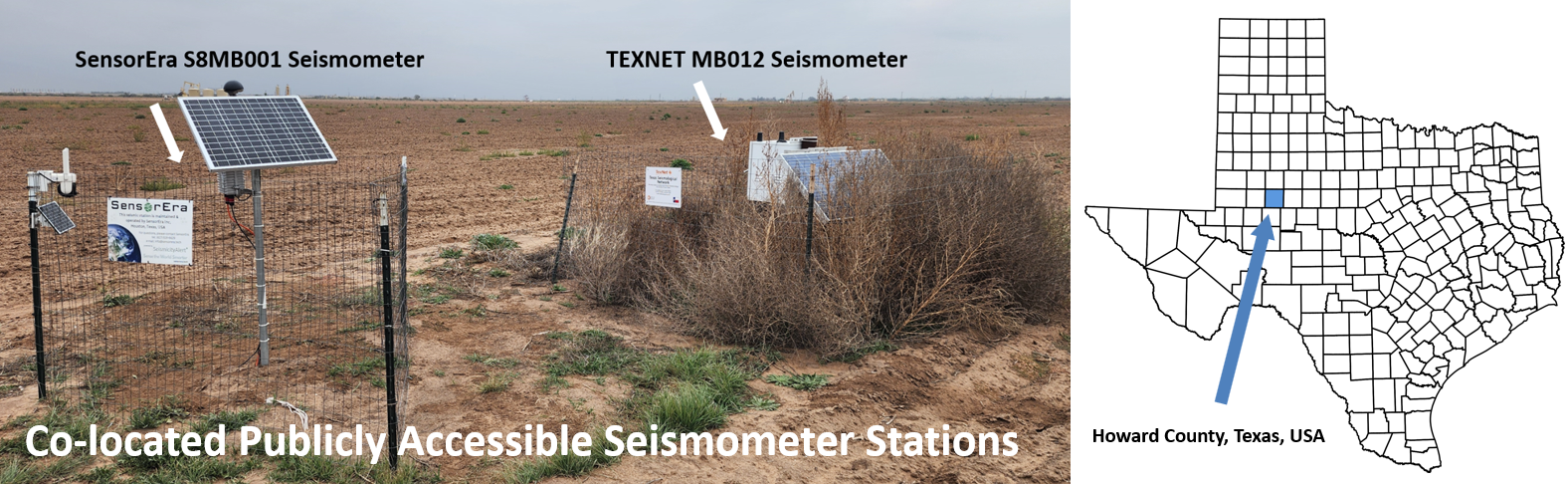
  • Benchmarked against TEXNET broadband seismometers (e.g. IRIS: S8.MB01 vs TX.MB12) - Live view below!
Solar-powered and equipped with GPS, 4G, Wi-Fi, webcam monitoring and continuously streaming miniseed data from the 9C and 6C twinned seismic sensors
LIVE DAILY COMPARISON TEXNET VS SENSORERA
SensorEra SeismicityAlert® (left) co-sited with a TEXNET reference seismometer station (right). Waveform comparison from regional and teleseismic confirms performance parity with conventional broadband instruments down to 0.1Hz (velocity sensor) and 0.03Hz (accelerometer). Check out the technical papers in our Media section and see live data from both stations below.
Click! — the live station feeds refresh on demand
−1.5 Mw
Detection floor
0.03–850 Hz
Bandwidth
130 dB
Dynamic range
<15 min
Alert delivery
02 — GPUSA's Surface Linear Vibrator (SLV)

A permanent, solar-powered, autonomous seismic source for frequent reservoir monitoring.

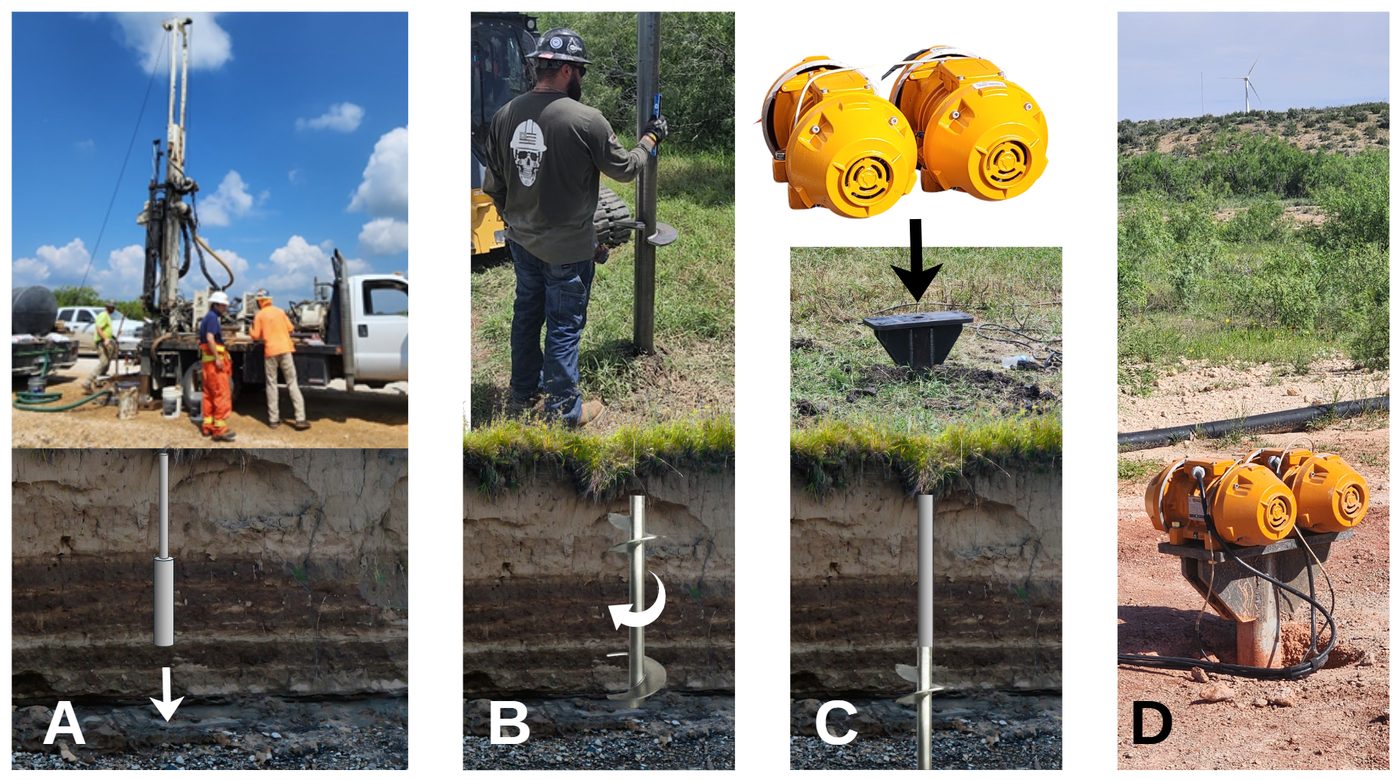
The MicroVibTM SLV, by GPUSA Inc, is a solar-powered, fully autonomous vibratory seismic source purpose-built for temporally-dense, spatially-sparse permanent time-lapse surveys. Two vibratory motors rotate synchronized eccentric weights on a hollow steel helical anchor driven up to 100 ft into the ground.

Because the anchor couples the source below the near-surface attenuating layer, the SLV delivers the repeatability that 4D reservoir work demands — without the weight, cost or manpower of a Vibroseis truck.
  • ~300 lb unit; >11,000 lb P-wave output force at 100Hz
  • Helical anchor ground coupling down to 100 ft below the ground level
  • Remote controlled over the internet or use pre-scheduled autonomous sweeps - daily, weekly, monthly etc.
  • Stackable in-phase for more force or out-of-phase as a phased array
  • Force-feedback controller keeps motors synchronized across the sweep
  • Deployable in cold, hot, marshland, swamp and environmentally sensitive areas
SLV installation in Midland Basin, Texas, from left to right: A) Pre-installation geotechnical survey B) Anchor installed to required depth C) SLV installed on anchor; D) Source is tuned by the operator before leaving site for unmanned nightly or weekly operations
An SLV installation in extreme weather in Canada, all equipment is mounted on piles to prevent subsidence and the SLVs are operated remotely from Houston, TX for SAGD injection monitoring.
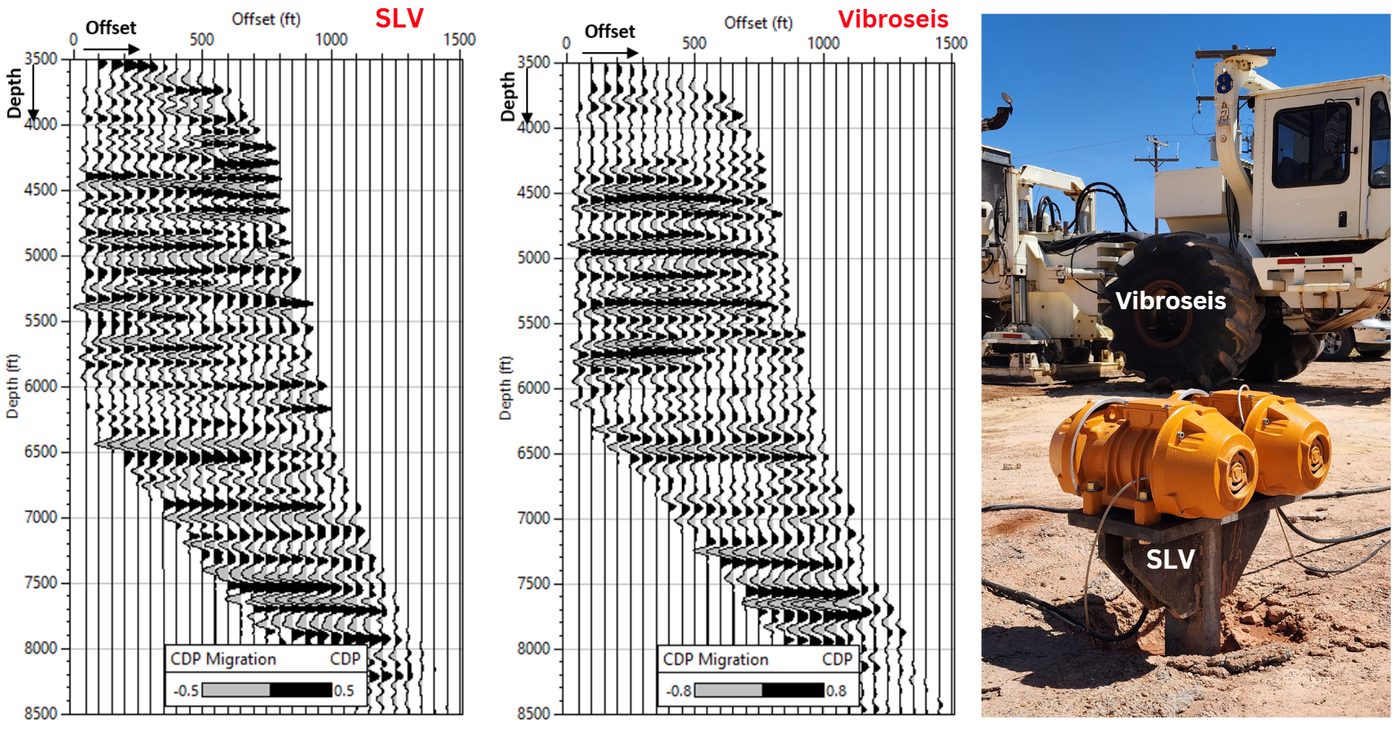
SLV vs Vibroseis: CDP VSP migrations from a side-by-side field test show the SLV resolving the same deep reflectors as a conventional Vibroseis truck.
11,000+ lb
Peak force
0–200 Hz
Sweep range
100 ft
Anchor depth
0
Field crew
03 — Integrated sensor gateway & cloud portal

One data logger. One portal. Every measurement.

The SensorEra data logger integrates an ultra-low-noise ADC with proprietary system-on-chip compression, streaming seismic and auxiliary data over 4G or satellite to a commercial cloud platform.

The gateway accepts third-party sensors so the asset team gets a single monitoring overview: seismic, gas, pressure, groundwater and weather all with webcam imagery and priority alerts by email, SMS, or automated voice.
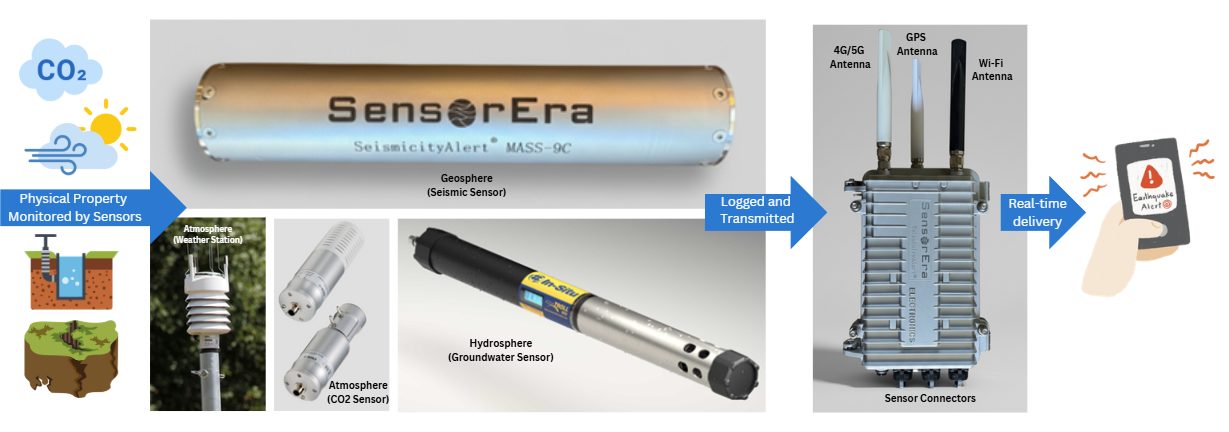
  • Seismic sensors (SensorEra 6C/9C, surface/downhole and third-party)
  • Expand with airborne and waterborne gas detection (CO2/methane/other)
  • Wellhead pressure and groundwater sampling compatible
  • Combined weather stations with wind-speed indicators for optimized time-lapse data collection
  • Webcams included (standard fit) for real-time station surveillance
  • Priority-tiered event alerts with full event log in the web portal
03 — Integrated sensor gateway & cloud portal
One logger consolidates geosphere (seismic), atmosphere (CO2 and weather) and hydrosphere (groundwater) sensors and transmits to the cloud portal in near real-time.

Our proprietary web portal and alert system is configured to your project requirements. When an alert arrives by SMS, email, or automated voice call, you can immediately open the portal on any device for a full situational assessment. Your monitoring network is displayed on a geospatial map with real-time station health alongside located seismic events and plume-front trace-tracking data. A single click on any event opens the full descriptive report. Behind the scenes, SensorEra super-users continuously verify station performance and push over-the-air firmware updates without any site visit.
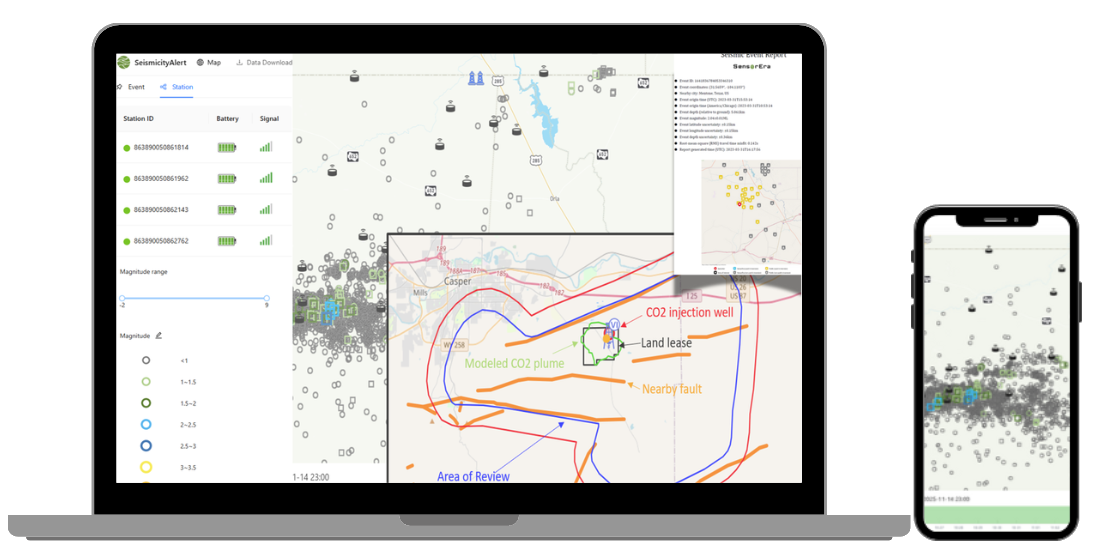
Our SeismicityAlert® web portal and alert system shows your sensor network information, monitoring results and contains all the relevant data and reports for download. Publicly available monitoring stations in your area of interest can also be included.
6
Sensor streams
<15 min
Alert delivery
3
Alert priorities
24/7
Portal uptime
Applications

When the ground moves, we measure it.

Originally developed for induced seismic monitoring at CCS sites, the same sensor platform can be and has been applied to other monitoring challenges.

Carbon Capture & Storage (CCS)

Carbon Capture & Storage (CCS)

Baseline, operational and post-injection seismicity monitoring. Active plume-front tracking with frequent (daily) unmanned seismic source and sparse receiver arrays.
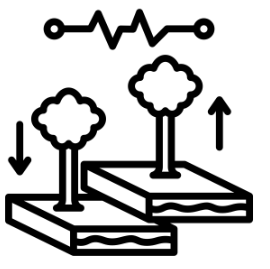
Regional Induced seismicity

Regional Induced seismicity

Continuous state-wide or county-scale monitoring for operators working in seismically active basins — validated side-by-side with conventional seismometers.

Hydraulic fracturing

Hydraulic fracturing

Real-time micro-seismic observations during stimulation for events >-1Mw, with real-time alerts.

Sinkhole detection

Sinkhole detection

Rapid deployment surface arrays flag precursor activity in karst-prone and subsidence-risk regions.

Infrastructure vibration

Infrastructure vibration

Bridges, dams, buildings, facilities and critical infrastructure — with real-time motion alerts.

Environmental compliance

Environmental compliance

Integrated gas-detection channels for CO2 and other gases in air and groundwater, continuously logged and reported.
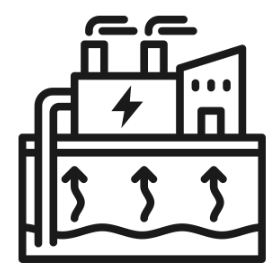
Geothermal

Geothermal

Monitor your hot rocks from the surface with a cost-effective dense array. Track fracture growth and monitor for seismicity across the area 24/7.

Steam-Assisted Gravity Drainage (SAGD)

Steam-Assisted Gravity Drainage (SAGD)

Permanent surface seismic arrays track subsurface steam cloud migration through continuous passive and active-source seismic monitoring.

Mining

Mining

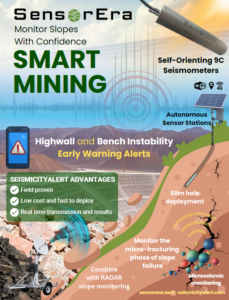
Monitor the mine (high wall) for structural integrity and let the sensed cracks predict failure before it happens.

People

The team behind the technology.

A friendly group of experts in geosciences, operations and data engineering and analytics who have spent careers in the fields of seismology, reservoir monitoring, subsurface imaging and autonomous systems.

Tianrun Chen PhD

Tianrun Chen PhD

CEO & Co-Founder

PhD in Acoustics from MIT, Tianrun brings 18 years of multidisciplinary expertise in acoustics, mechanical engineering, and geophysics. He held senior technical and project management roles at Halliburton and Shell, leading sensor hardware and algorithm development and overseeing multi-million-dollar seismic acquisition and processing projects.

LinkedIn →

Xinding Fang PhD

Xinding Fang PhD

CTO & CO-FOUNDER

PhD in Geophysics from MIT and brings 14+ years of expertise in seismic characterization, petrophysics, and geomechanics. He is the author of over 80 research publications and holds multiple patents in borehole geophysics and rock mechanics. He received the 2019 SEG J. Clarence Karcher Award for outstanding contributions to exploration geophysics.

LinkedIn →

Siwei Li PhD

Siwei Li PhD

Chief Scientist

A computational geophysicist and applied mathematician, Siwei began his career at Chevron in 2014 developing cutting-edge seismic processing techniques before moving into a multi-disciplinary deep-water exploration role. He holds a BSc in Geophysics from Peking University and a PhD from The University of Texas at Austin.

LinkedIn →
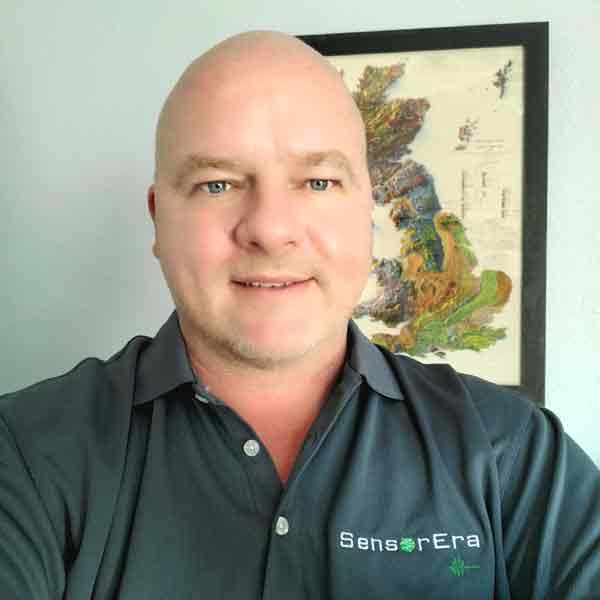
Nicholas Brooks MSc

Nicholas Brooks MSc

BD & Ops Consultant, International

25+ years of technical & leadership across CGG, Baker Hughes, Weatherford and READ Group, spanning borehole geophysics & BD across the Americas. Founded his consultancy Magma Geoscience in 2017. BSc in Exploration Geophysics from UCL and an MSc in Basin Evolution & Dynamics from Royal Holloway.

LinkedIn →

Jason Schweigert MSc

Jason Schweigert MSc

BD Consultant, Canada

A Data Acquisition Geophysicist with 25 years of experience, began his career at Veritas DGC before joining BJV Design, where he holds a leadership role focused on BD and technology. He has designed and modelled over 3,000 seismic programs worldwide, and holds a BSc and MSc in Geophysics from the University of Calgary.

LinkedIn →
Media

Published evidence from the field and the office.

SensorEra technology is documented in peer-reviewed journals and conference proceedings. Key results from many passive and active seismic monitoring projects can be downloaded here & for a lighter read we include some informative flyers.
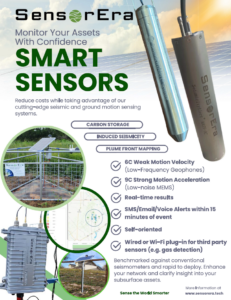
Informative Flyers

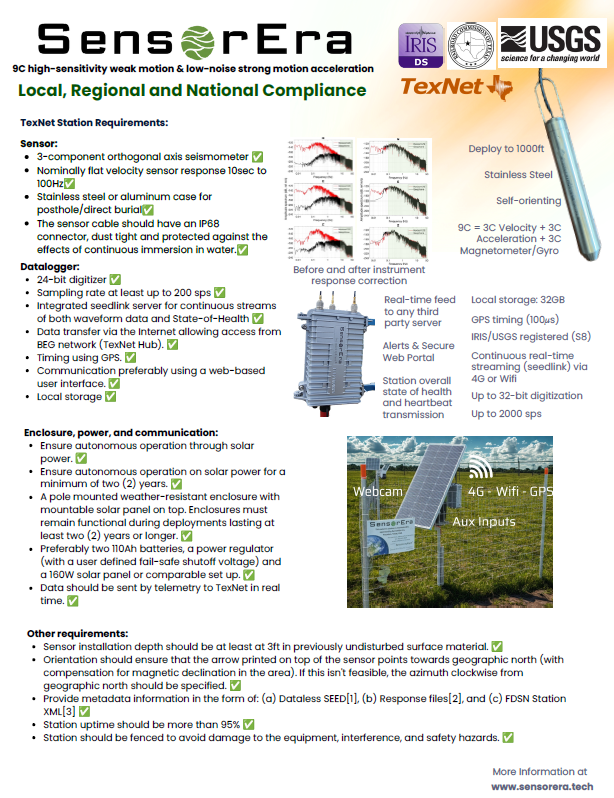
SeismicityAlert® Seismometer Gen4

Download PDF ↓

MicroVib® by GPUSA

Download PDF ↓

Mining - Slope Stability

Download PDF ↓

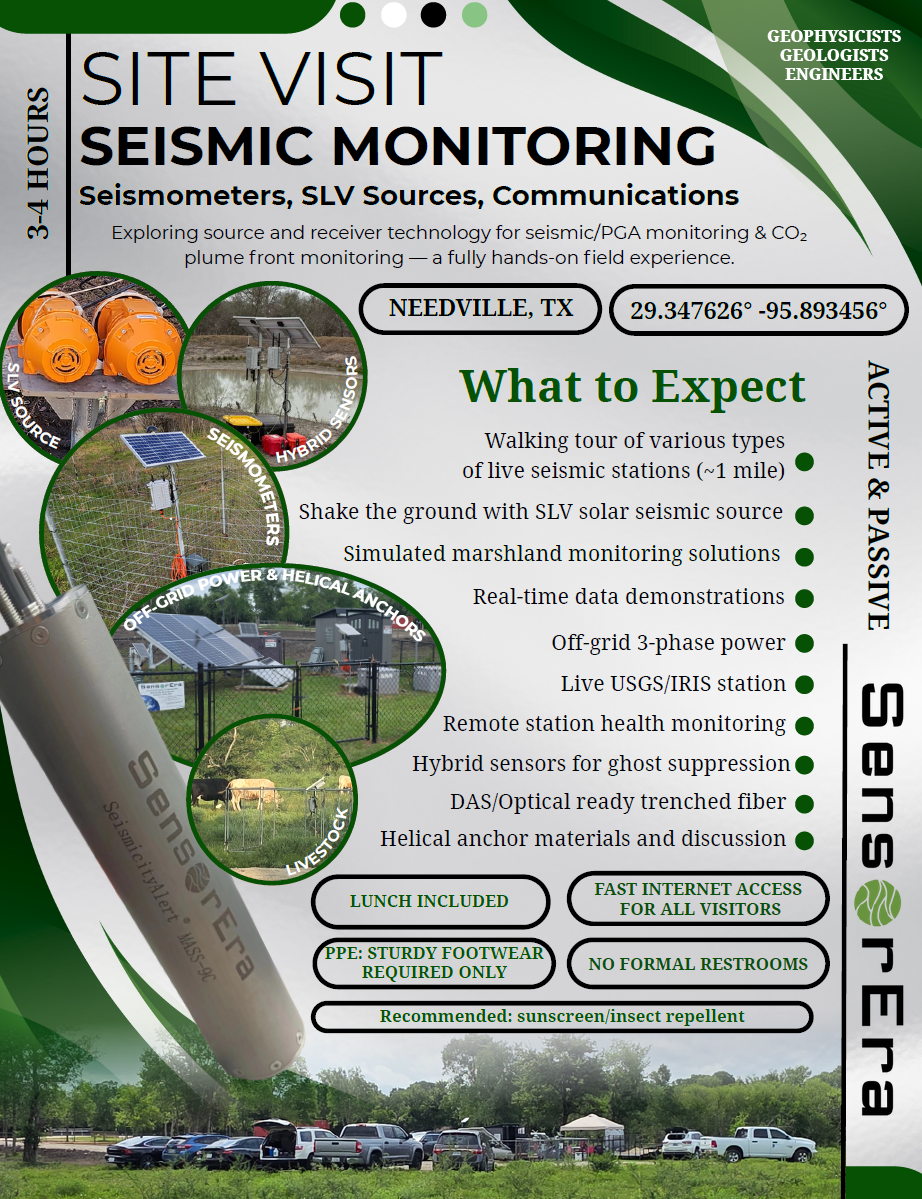
Visit our test site! - use contact form

Download PDF ↓

Technical Publications

Comparison of geophone and seismometer for regional-scale induced seismicity monitoring

2026 • Conference • International Meeting for Applied Geoscience & Energy
Available August 2026 →

Evaluation of low-cost 5Hz geophones for regional earthquake monitoring: a field comparison with broadband seismometers

2026 • Conference • International Meeting for Applied Geoscience & Energy
Available August 2026 →

Cost-effective time-lapse seismic characterization of fracture dynamic changes

2025 • Conference • International Meeting for Applied Geoscience & Energy
Read paper →

Field trial of a sparse and automated seismic acquisition system with permanent anchored vibratory sources

2025 • Conference • International Meeting for Applied Geoscience & Energy
Read paper →

Design & installation of a light-weight permanent reservoir monitoring system

2025 • Conference • First EAGE Workshop Land Seismic Acquisition
View abstract →

A new double-difference earthquake relocation algorithm for models with complex velocity structure

2024 • Conference • Fourth International Meeting for Applied Geoscience & Energy
Read paper →

Evaluating the effects of velocity models and array configuration on induced seismic event locations in the Permian Basin

2024 • Journal • GEOPHYSICS
Read paper →

Development of an affordable new seismic source-receiver system for 4D mapping of CCS plume fronts and passive seismic monitoring

2023 • Conference • International Meeting for Applied Geoscience & Energy
View presentation →

Comparing Rapid Deployment of New Microelectromechanical Systems (MEMS) Seismic Stations vs. Traditional Seismometers for Detection of Near Field and Far Field Earthquakes

2023 • Conference • International Meeting for Applied Geoscience & Energy
Read poster →

A novel and low-cost seismic acquisition system consisting of permanent controlled linear vibratory sources and new autonomous seismic sensors for CCS/CCUS site characterization, plume front mapping and real-time seismicity monitoring

2023 • Conference • International Meeting for Applied Geoscience & Energy
Read paper →

Induced seismicity in Howard County V: Technical and regulatory challenges for induced seismicity and deep disposal of fluids

2023 • Conference • International Meeting for Applied Geoscience & Energy
Read paper →

Induced seismicity in Howard County IV: Numerical investigation of wave propagation in a complex layered sedimentary basin velocity field and the impact on travel paths and event locations

2023 • Conference • International Meeting for Applied Geoscience & Energy
View presentation →
Clients, Partners & Collaborators

Thank you to our trusted friends in our shared technology space.

SensorEra integrates proven components from leading sensor, connectivity and cloud-platform vendors — and collaborates with other companies, as well as academic and research institutions on technology validation to provide a valuable service to our clients

Birch
Carbon Seismic
Chevron
ConocoPhillips
CRC
CSUB
EnergyTransfer
Entropy
ExxonMobil
GPUSA
HighPeak
IGS
Imperial
Inpex
Interpipeline
Lapis
OU
Paramount
PilotWater
Shell
SMEnergy
Spartan
Tallgrass
TotalEnergies
Trinity
UH
Whitecap
Get in touch

Planning a subsurface monitoring project?

Tell us about your project — seismicity, mining, CCS, geothermal, Oil & Gas or other — and we'll be in contact as soon as we can

General enquiries
Use this form and we will receive your message
Headquarters
2245 Texas Drive, Suite 300, Sugar Land, Texas, 77479
Follow us
LinkedIn
Global seismic monitoring
Sense the World